The five things you need to know about the housing market this week.
1. Affordability has returned to normal
The latest Cotality Housing Affordability Report brings good news for buyers and renters, with all four affordability measures dropping to their long-term average, or even a bit below. Lower house prices and lower rents have played their part, but so too have income growth and falling mortgage rates. Housing isn’t cheap, but prolonged weakness in the housing market has made it easier to get on the property ladder.
For example, the value-to-income ratio is now 6.7, right in line with the average since 2004, and significantly below the peak of 9.8 in late 2021. Saving for a deposit takes 8.9 years, a touch below the long-term average of 9 years. Meanwhile, perhaps the most meaningful measure for most people is mortgage payments as a share of household income. It now stands at 40% – below its own long-term average of 42%, and well down from the peaks of 54%.
Start your property search
The figures found Tauranga was the least affordable major metro to buy and own property, and Wellington the cheapest. However, compared to its long-term average, Tauranga isn’t as stretched as Christchurch, Hamilton, and Dunedin.
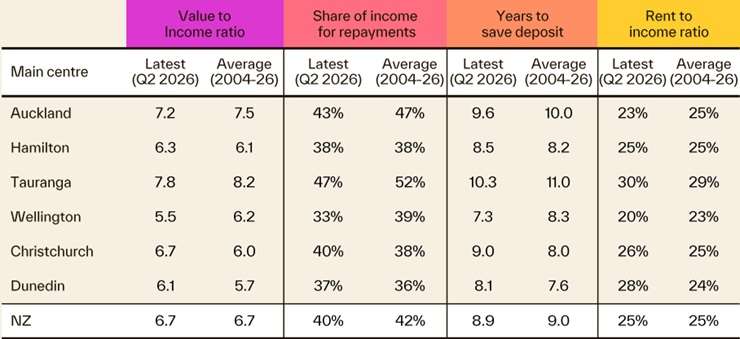
Cotality Housing Affordability measures. Graphic / Cotality
The extended weak patch in rents has also improved the situation for many renters. Indeed, the median weekly rent as a percentage of household income has dropped to around 25%, in line with the long-term average. The caveat to this is that a typical renting household may earn less than the average income.
None of this necessarily means we’re about to see a fresh boom in house prices or rents, but a more normal foundation for affordability probably does limit the scope for any further significant falls.
2. Inflation isn’t dead, but it’s not spiking either
The selected price indexes (SPI) track the monthly price changes for a selection of goods and services that Kiwi households purchase. July’s figures, released by Stats NZ last week, highlighted subdued results for fuel, food, rents, and household energy. It’s early days, but these figures add to other evidence that inflation may have already peaked in the June quarter, at 4.1%. That said, even an inflation figure in the high threes in Q3 would still be a problem. Expect the Reserve Bank to raise the Official Cash Rate (OCR) on September 2.

Cotality chief economist Kelvin Davidson: “Housing isn’t cheap, but prolonged weakness in the housing market has made it easier to get on the property ladder.” Photo / Peter Meecham
3. Is the economy slowly turning a corner?
Last week’s electronic card spending figures from Stats NZ and the BNZ-BusinessNZ Performance of Services Index both improved, further bolstering the case for another OCR rise. For further economic guidance, I’ll be watching the NZ Activity Index on Thursday this week and ANZ’s consumer confidence survey on Friday. Of course, for mortgage holders, this nascent good news might actually be bad, if a stronger economy meant higher interest rates.
4. Keeping an eye on home loans
Speaking of mortgages, on Wednesday this week the Reserve Bank will publish July’s lending figures and, as has been the case for a while now, there’ll be a focus on the split by debt-to-income ratio – are the speed limits being tested? The figures will also be broken down by loan type, and recently, bank switching has been running at reasonably high levels by past standards.
5. Modest employment growth?
Also look out for July’s filled jobs figures from Stats NZ on Friday this week. Given the continued challenges many businesses are facing, employment has actually been pretty resilient lately, so let’s hope for more of the same. Broad stability in employment underpins housing too.
- Kelvin Davidson is chief economist at property insights firm Cotality