- Wellington’s new property-value-based water charges are raising bills, and alarming homeowners, landlords and retirees.
- Critics say unmetered charges unfairly penalise higher-value homes and could prolong the region’s housing slump.
- Tiaki Wai plans to reduce reliance on property values, but meters may take seven years.
There are fears Wellington’s new water charges could put further pressure on property owners and force landlords to sell up and retirees to quit their homes.
Start your property search
Critics say the new system, introduced this year, could prolong the capital’s housing slump.
Wellington ratepayers have been issued with new water bills in recent weeks, and some are facing demands for hefty sums.
The cost of water usage was previously rolled into a homeowner’s council rates bill, but the two have been separated.
The new water bills issued by newly set-up water services provide Tiaki Wai are based on a property’s capital value, either partially or fully, depending on which council the property falls under, and do not reflect how much water a property uses.
This has led to homeowners in higher-value properties paying hundreds of dollars more for water, say critics, and comes at a time when the region’s creaking water infrastructure is under scrutiny.
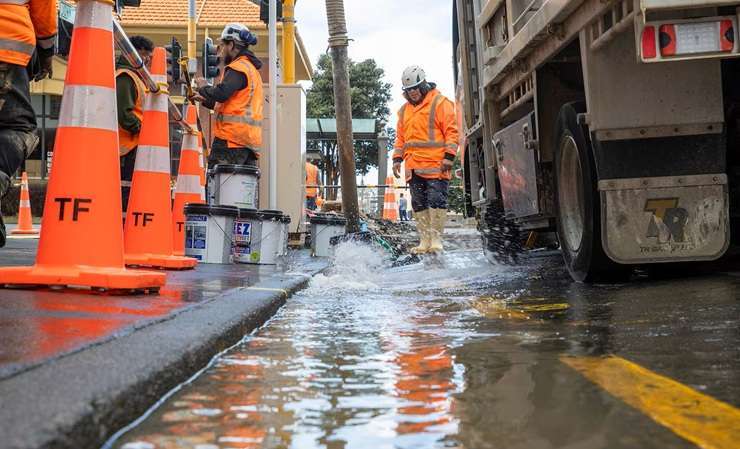
Part of Tiaki Wai’s remit is to fix the city’s failing infrastructure. Photo / Mark Mitchell
Wellington investor Steve Goodey, who owns several properties in the region, claimed older homeowners who could not afford the rate increases were at risk of being “kicked out of their houses”.
Goodey has a home in Mount Victoria with an RV of $2.58m. It has an annual rates bill of just under $13,000 and a water bill of over $5450. With three people in the house, that works out to be just over $1800 per person for water.
Whereas the six-bedroom boarding house in Kilbirnie he owns would have an annual rates bill of just over $4480, based on an RV of $540,000, and an annual water bill of $2183 – $363.83 per person for water.
Goodey’s combined council and water rates for these properties have gone up more than the city’s average of 5.8%. The Mount Victoria property’s bills had risen by just over 7%, while bills for the Kilbirnie property were up by 9.6% year-on-year.
Discover more:
- ‘Sick of being beaten up’: Wellington hits back after smashing from Aussie real estate star
- Coach at centre of slap video quits social media, lists properties for sale
- $130K not enough to rid of 'dangerous' dump with million-dollar views
“That’s the extra rip-off ... but the primary rip-off is do people paying 530% more than other people use that much more water? It has stopped being a user-pays system.”
Goodey said most of his properties were boarding houses, so he was actually better off, but he was concerned for those who were unfairly impacted.
“Most of my investment properties are large-scale multiple units or boarding houses, so I’m not the one getting smashed on this. But it’s people like my mum who are.”
A Tiaki Wai spokesperson said plans to move away from RV-based calculations would begin next year and address the disparity, but the decision to use water meters was awaiting board sign-off. Homeowners could be waiting up to seven years for a meter.

Wellington property coach and investor Steve Goodey says the water charges are a “rip-off”. Photo / Supplied
The authority said measures were in place to help those struggling to pay their bills.
It had no legal authority to force the sale of any property for any unpaid water bill so noone would be kicked out because of it, the spokesperson said. The most it could do in the case of non payments would be to get a debt collector involved.
“No one’s water will be turned off because they have not paid their bill.”
Harcourts Team Realty owner Marty Ritchie said Porirua City Council’s new water bills only arrived last week, so it was too early to tell the impact on the property market just yet, but he didn’t think it would be good news.
“I looked at mine today, and my rates bill went back fractionally. But on average my water bills were $2300, and that’s for 12 months.”
Ritchie said the lack of water meters not only impacted homeowners with single or small households, who might use less water, but also would sting investors.
“All of a sudden, it’s going to make quite a difference, and unless you as a landlord have a meter on there, you cannot on-charge the tenants for any usage because there’s no way of measuring it.”
The new water bill was just another cost landlords were grappling with, he said, warning it could result in some selling up.
“Rents have come back but costs to landlords have gone up. If there’s no incentive, then people will decide that they don’t want to be in the landlord game anymore and they’ll get out of housing.”
He said retirees who were not sitting on large nest eggs could also be at risk because while it appeared his rates had come back a bit, he did not believe they would cancel each other out.
“I’m sure there’ll be some extra costs.”
Wellington Ratepayers’ Alliance spokesperson James Ross said the real issue was that rates bills had not fallen in line with councils’ previous water costs.
“So now that water is being billed separately, ratepayers are facing costs much higher than the 5.8% increase would suggest.
“Everyone is affected, but particularly those on fixed incomes. The number of people needing assistance with their rates bills is up 150% over just the last two years. And with water bills set to triple over the next decade, that’s only going to get worse.”
He said a lot of people were angry because the separate water bills made it clear how much people were paying for “sub-par services”.
Tommy’s agent Jason Lange said the current water charging system could be viewed as “unfair”.
“When you’ve got a retired lady in a million-dollar home using 10 litres of water a day, and then there's a student flat next door with 10 residents in it using 200 litres of water, and they’re paying the same effectively. So that could be seen as a bit of a problem.”
He added: “It’s too early to say I think whether it’s going to have an impact on the market or not. I mean, if you want to live in Wellington, then you’ve got to pay the rates and the water rates.”
Infometrics chief forecaster Gareth Kiernan said while higher rates and water bills may not necessarily drive prices down, it could prolong the weakness in the market.
“Obviously the Wellington property market has been under pressure for three years or so with the weaker economy, public sector jobs and spending cuts, which have negatively impacted activity, employment and population growth. We’ve seen people choose to leave Wellington for opportunities elsewhere.
“If you add a layer of additional spending cuts on top of that, it certainly does make it difficult for the market to recover.”
- Click here to find properties for sale in Wellington