
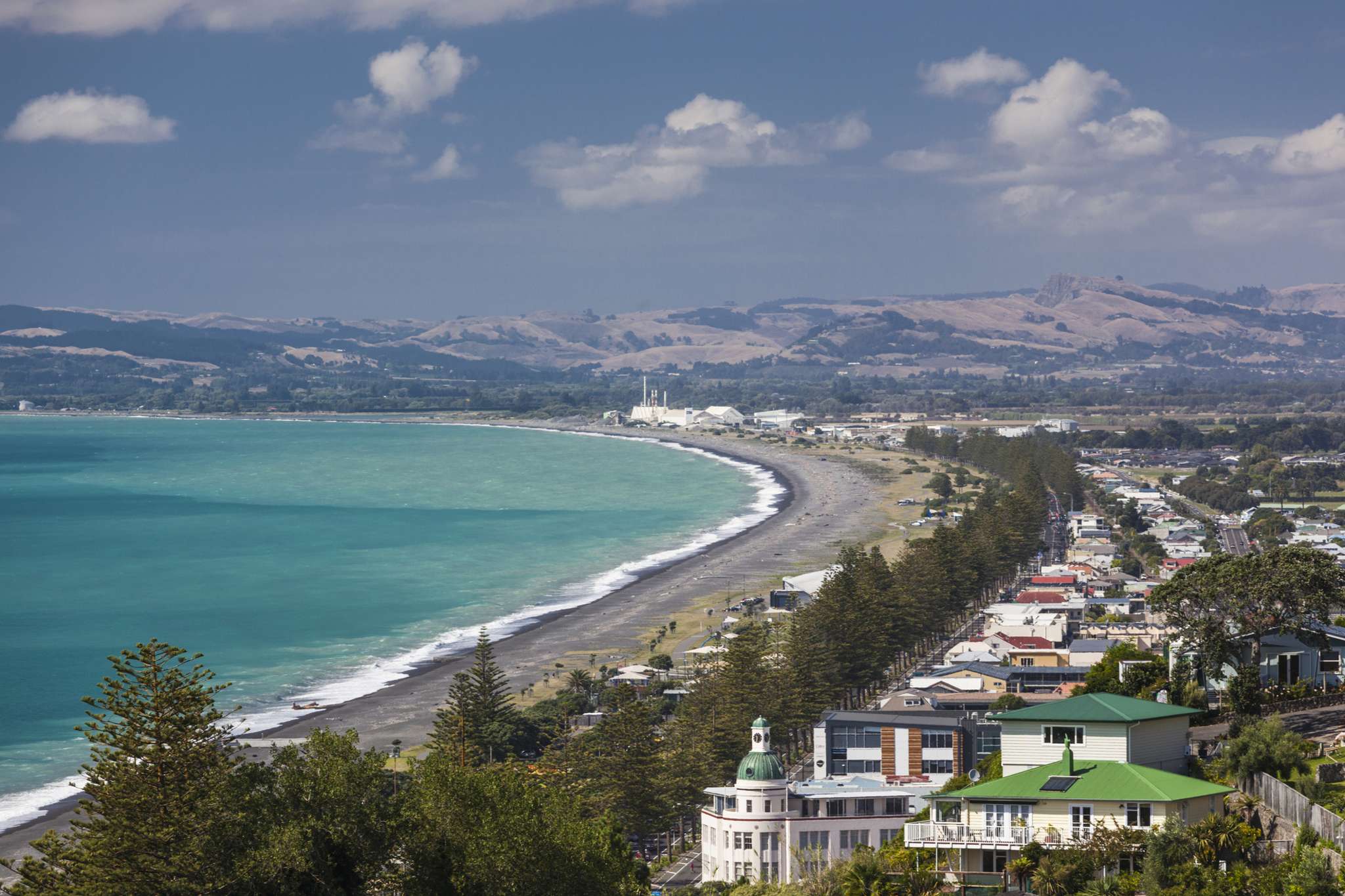
Napier was founded around the middle of the 19th century as a port town, but it was the 1931 the Hawke’s Bay earthquake that put it on the map. Around 3000 hectares of land was lifted above sea level, the city centre destroyed. The city’s rebuild was carefully planned as a celebration of the groovy new Art Deco style emerging around the world. These days people come from all over the world to see the well-preserved heritage town centre and heritage homes.
Te Awa, to the south east of the city centre is a suburb of two halves: there are still pre-quake dwellings, including small railway workers’ houses from the 1920s, plus Art Deco style homes built after the quake.
More recent properties are from the 1960s and 70s.
On the other side is Te Awa Fields, a new subdivision of 67 homes, in front of Maraenui Golf Club. This is the newest of the subdivisions in the area, which began around twelve years ago adding hundreds of high-quality homes to the suburb.
Start your property search
Developers have been careful not to create a cookie cutter identical builds on standard-sized sections, instead offering a range of different properties: larger ones for families, and smaller sites for people who are downsizing. Streets are in small cul-de-sacs to promote a sense of community and allow children to play safely.
Retirement village developer Summerset has been granted resource consent for a large complex on a nine-hectare site, also close to Maraenui Golf Club. It will be a small townwithin-the town with 320 units in a mix of two and threebedroom villas, one-bedroom apartments, a rest home and hospital wing, workshops, social centres and a communal vege garden.
Who lives here and what do they do?
Te Awa’s broad range of residents include families who appreciate its close proximity to Napier Boys High School.
The transition of the area is shown in OneRoof data where 16 percent of residents work as labourers while 21 percent are professionals. Many residents who previously had big homes elsewhere in the city are attracted to the subdivision both to be part of a community, and to reduce home maintenance in a brand new house.
What’s to love?
The best thing about living in Te Awa is its position just a few minutes’ drive to the city along Marine Parade, close to the foreshore reserve and the beach. There’s a cycleway which many locals use for daily commutes: the trip to work doesn’t get much better than the stunning sea views en route.
There’s a strong café culture in Napier with popular establishments in the city itself as well as in surrounding suburbs such as the rapidly developing Ahuriri, and nearby Taradale, with its wineries.
Because Te Awa is close to the state highway to Hastings and Havelock North, the surrounding countryside and vineyards are in easy reach by car or cycle trail for wine tasting, cellar door sales and restaurants.
Napier has beautiful parks and gardens but having the Maraenui golf club practically on the doorstep is a big Te Awa attraction, with its lovely tree lined grounds and the sea breeze
Families are drawn to Te Awa because it is quiet and safe, with a good primary school.
Children enjoy playing on the beach and paddling in the sea and there’s mini golf, playgrounds and a sunken garden. Along the waterfront heading to the city is a skate park for the teens.
Buying and selling
While other markets around the country have paused, or even cooled off recently, that certainly isn’t the case in Hawke’s Bay and Te Awa is no exception.
Property values in the suburb have risen considerably in the past three years - some 63 percent - with the median value now sitting at $482,000.
Tremains Hawke’s Bay sales manager Stuart Christensen says that first-home buyers will struggle to find anything priced much below $500,000 even in the older part of the suburb.
“You’ve got issues of supply and demand and property is snapped up quickly, often with competing offers,”
He says that sections in Te Awa Fields start at around late $200,000s while larger ones will be in the low $300,000s.
“When they’re finished we’ll be looking at $700,000 houses.”
Christenson says that some of the homes in the first part of the subdivision, built around 12 years ago, are now coming to market for around $800,000.
“The reason for this is that they’re huge, American-style properties, with an extensive floor area, but today’s homes are not as large as that.
“I think ultimately what’s happening is that you’ve got a nice climate, you’re close to town, interest rates are low and Napier only has a finite amount of land zoned for housing.”