OneRoof’s Ask the Expert series is aimed at helping consumers cut through the noise when buying goods and products for their home. It’s hard to make a decision when there’s so much out there, so who better to trust than the people who have the expertise and use these items for a living?
Many of us have been there. The idea of a cosy outdoor fire, toasting marshmallows or enjoying a drink by flickering flames. Then reality hits with a face full of smoke after using a whole pack of firelighters to get it started.
So, what is the best outdoor fireplace for ambient evenings, and is it freestanding, fixed, a firepit and wood or gas?
Angela Hiddleston, founder of Design for Fires and one of New Zealand’s only independent fireplace design specialists, has spent 20 years advising on fireplaces. She has three wood fires herself, two indoor and one outdoor.
Start your property search
“The biggest mistake people make is choosing the fire first and then expecting everything else to be designed around it,” says Angela.
Decide whether you want cooking, serious heat, atmosphere or all three, and whether the space is for quiet family evenings, large groups, or both.
Design the space before choosing the fire
Hiddleston says consider where people will sit, their distance from the fire and whether the space is open, exposed or partly enclosed.
Peter Fraser, director of Inferno Outdoors, agrees, saying homeowners should also consider any future pergolas, louvre roofs, blinds or other structures that could affect the fire’s placement and even consenting requirements.
Fraser recommends positioning a fire with its back to the prevailing wind to reduce smoke and urges buyers to consider how the sun moves for that late afternoon light.
Bigger is not always warmer
“The biggest problem I’ve seen over 20 years is that people think bigger is better. They want the biggest fire, but big fires require a lot of fuel and can be hard to get hot enough to work properly,” says Hiddleston.
A larger firebox needs a substantial flue, sometimes two, and enough wood for an effective draw. Too little wood means the flue may not get hot enough and the fire smokes.
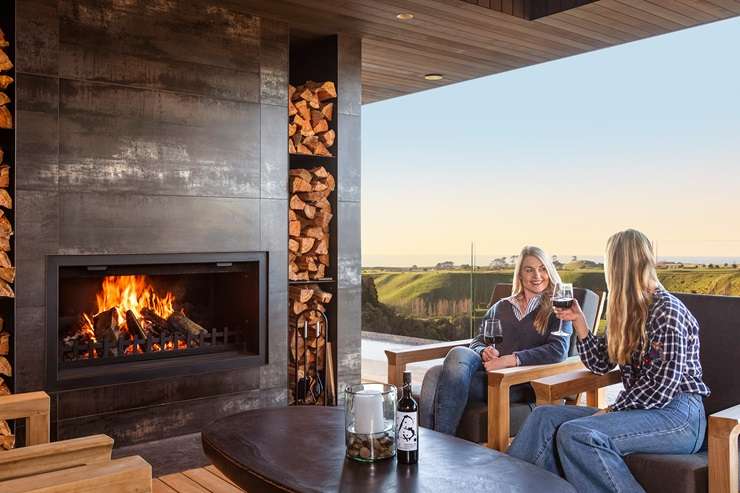
Trendz Outdoors has a range of outdoor fires and steel firebox inserts. Photo / Supplied
Fraser says wet wood, wind exposure and a chimney too short to disperse smoke quickly can also cause ongoing smoke problems for homeowners and neighbours.
Trendz Outdoors, as seen on The Block, offers a range of both outdoor fires and steel firebox inserts to customise your space. If you insist on going big, models like the Twin Peak are about as big as you can get.
Don’t overlook weight and access
Fraser says another mistake is treating an outdoor fireplace as an afterthought in a new build or landscaping project.
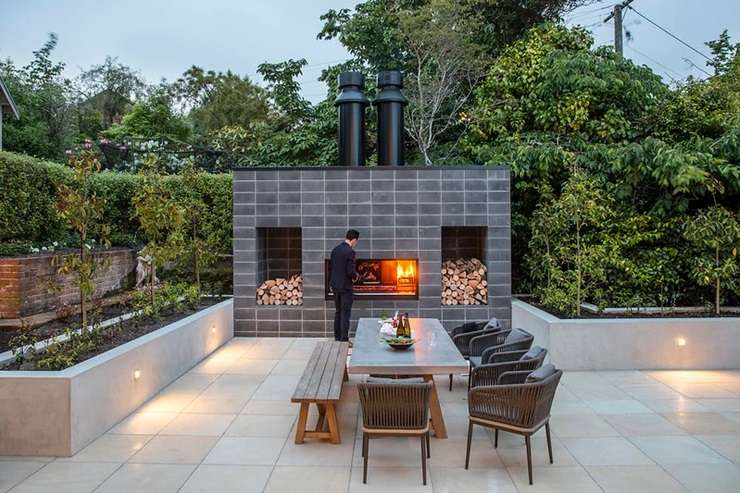
Precast concrete fireplaces can weigh between two and 3.5 tonnes, so installation may require a HIAB, crane or specialised spider crane.
Fires also need a foundation capable of supporting their weight.
Inferno offers a range of outdoor fireplaces, including solid concrete with concrete foundations from the Patio to the Mega Side Stacker. It also has a Corten steel version that is built for New Zealand weather and will develop a weathered rust coloured patina over time.
Check consent, boundaries and ventilation
Along with considering use and placement, outdoor fireplaces must comply with building requirements, including clearances from boundaries and other structures.
Hiddleston says a freestanding outdoor fire is unlikely to need building consent, but if it is attached to the house or its flue passes through the roof or building envelope, people are likely to need building consent and an engineer.
The Escea EK1250 Outdoor Wood Fireplace by Stoke Fires. Photo / Supplied
Fraser says early advice can identify council requirements before committing to a product or building. If you are going built-in, Stoke Fires offers a range of built-in fireplaces in wood, gas or electric, starting with the entry-level Escea EK1250 Outdoor Wood Fireplace.
If you’re considering gas, Angela says ventilation is particularly important in partly enclosed outdoor rooms.
“A flueless outdoor gas fire cannot simply be installed in a three-sided enclosed space,” Hiddleston says. “You have to think seriously about ventilation and carbon monoxide.”
Fire pits also need a non-combustible surface and heat protection rather than being placed straight onto a timber deck.
What’s best? Fireplace, fire pit or gas?
For smaller budgets, Hiddleston recommends freestanding fireplaces or fire pits like those offered by Metro Fires. They avoid the construction, installation and material costs of a permanent structure.
Buschbeck also does a range of outdoor fires and pizza ovens, with the Rhondo, sold at Mitre 10, receiving good reviews.
Flare also offers a Signature or Elite Series of free-standing fireplaces it describes as “rapid set up” and “plug-n-play straight out of the box”.
A good-quality fire pit can also be accessible. But Hiddleston says people shouldn’t assume all products marketed as “smokeless” perform equally well.
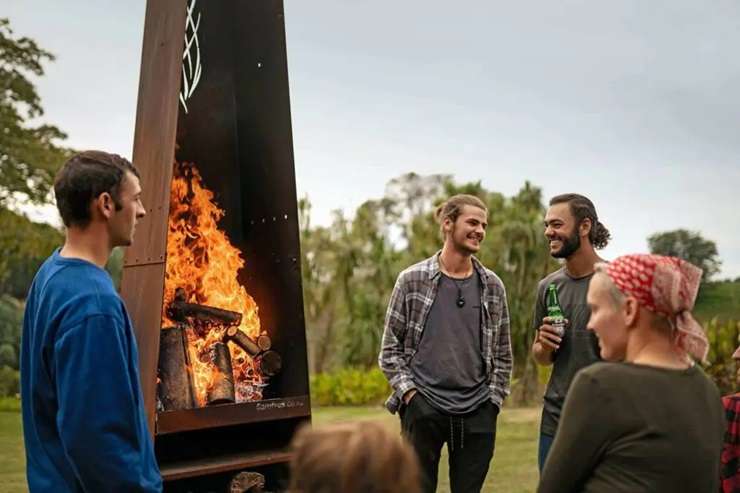
The Martello COR-TEN outdoor fireplace. Photo / Supplied
Metro also does a range of fire pits, starting with the 540 Fire Pit C, which comes with a cooking kit and deck protector.
These ones from Wizard have 1000 positive reviews and start with this affordable tiny tabletop version, all the way up to the Jumbo version.
If you’re wanting bespoke and handmade in New Zealand, have a look at Smokelis.
Hiddleston says gas fires offer convenience, instant ignition and controllable heat, but flames can be hard to see during the day, so they may not provide the ambience expected.
The Stoked Escea EF5000 Outdoor Gas Fireplace is its most popular gas model. It also offers a range of outdoor heaters if warming up your space is the sole focus.
Choose materials for the environment
Finally, a fireplace exposed to New Zealand weather needs materials and finishes suited to its location.
“A lot of New Zealand is coastal,” Hiddleston says. “If the fire is going to remain exposed, marine-grade stainless steel is the best option because ordinary steel will rust.”
A stainless-steel cover can extend the fire’s life, particularly over winter.
Flare's Martello COR-TEN is made of Corten steel and comes on a rotating base to angle it away from the wind.
Hooga also does a good range of Corten steel fireplaces.
Ultimately, both experts recommend involving a fireplace specialist early rather than choosing on appearance alone.
“People go into a showroom and are seduced by the fire, but they don’t always apply it to their own situation,” Hiddleston says. “Choose the fire only after you understand the space, the heating you want and how you’re actually going to use it.”